


List of previous clergy
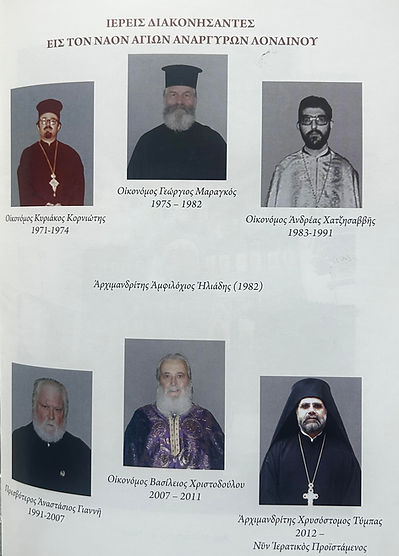
Οἰκονόμος Κυριάκος Κορνιώτης (1971–1974)
Fr Kyriakos Korniotis (1971–1974)
Ὁ πρῶτος ἐφημέριος τοῦ Ναοῦ καὶ θεμελιωτὴς τῆς ἐνοριακῆς ζωῆς.
The first parish priest and a foundational figure in establishing the Church.
Οἰκονόμος Γεώργιος Μαραγκός (1975–1982)
Fr Georgios Marangos (1975–1982)
Συνέχισε καὶ ἐνίσχυσε τὸ ἔργο τοῦ Ναοῦ, ἰδίως στὴν παιδεία καὶ τὴν νεολαία.
Continued and strengthened the life of the Church, especially in education and youth development.
Ἀρχιμανδρίτης Ἀμφιλόχιος Ἠλιάδης (1982)
Archimandrite Amfilochios Iladis (1982)
Διηκόνησε γιὰ σύντομο διάστημα μὲ θεολογικὸ βάθος καὶ συνέπεια.
Served briefly with theological depth and dedication.
Οἰκονόμος Ἀνδρέας Χατζησαββῆς (1983–1991)
Fr Andreas Hadjisavvas (1983–1991)
Ἀνέπτυξε τὴν νεολαία καὶ ἐνίσχυσε τὴν λειτουργικὴ καὶ κοινωνικὴ ζωή.
Expanded youth work and strengthened both liturgical and community life.
Πρεσβύτερος Ἀναστάσιος Γιαννῆ (1991–2007)
Fr Anastasios Giannatos (1991–2007)
Ἔφερε σταθερότητα, ἐνότητα καὶ συνεχή πνευματικὴ παρουσία στὴν ἐνορία.
Brought stability, unity, and consistent pastoral care to the parish.
Οἰκονόμος Βασίλειος Χριστοδούλου (2007–2011)
Fr Vasileios Christodoulou (2007–2011)
Συνέχισε τὴν διακονία μὲ ζῆλο καὶ ποιμαντικὴ φροντίδα.
Continued the ministry with dedication and pastoral care.
Ἀρχιμανδρίτης Χρυσόστομος Τύμπας (2012–2023)
Archimandrite Chrysostomos Tympas (2012–2023)
Νῦν Ἱερατικὸς Προϊστάμενος τοῦ Ναοῦ, συνεχίζων τὴν πνευματικὴ πορεία τῆς κοινότητος.
Continued the spiritual journey and growth of the community.
The Church of the Holy Unmercenaries (Saints Cosmas and Damian), London
Historical Overview and Development
Foundation and Early Organisation
The early development of the Church of the Holy Unmercenaries was driven by a committed group of founding members who formed the first church committee. Key figures included:
Andreas Avgoustis (President)
Zinon Tsietras (Vice President)
Michail Pieri (Treasurer)
Chrysostomos Philippou (Secretary)
Theodoros Papachristou and Stelios Karasialis (Members)
These individuals worked collectively and selflessly to establish the Church, often under difficult financial and practical conditions. Their efforts included fundraising, overseeing construction works, and supporting the acquisition of adjacent land to secure the Church’s future expansion.
Establishment of the Church Building
The Church faced significant early challenges, including inadequate infrastructure such as heating and flooring.
In 1972, a loan was sought to install central heating, greatly improving conditions.
Efforts were also made to acquire neighbouring land from the local authority (London Borough of Camden), although this request was ultimately declined.
Despite these obstacles, the community persevered through collective effort, donations, and voluntary work.
Consecration of the Church (1975)
A major milestone in the Church’s history was its consecration in 1975 by Archbishop Athenagoras.
The consecration followed traditional Orthodox practice, including:
The placement of holy relics within the altar
The sealing of the altar with a mixture of wax, mastic, myrrh, and incense
The anointing of the Church walls with holy chrism
This marked the transformation of the building into a fully consecrated Orthodox temple, establishing it as a spiritual centre for the faithful.
Development of Community Life
Following consecration, the Church gradually evolved into a structured and active community.
Key developments included:
Regular liturgical services
Formation of a women’s auxiliary association
Fundraising initiatives to support the Church and those in need
Strengthening of parish organisation
The Church became not only a place of worship but also a centre for social and charitable activity.
Education and Youth Formation
Catechetical School
A catechetical school was established to teach children the foundations of the Orthodox faith.
Children were instructed in:
Christian doctrine
Orthodox traditions
Participation in church services (including altar service for boys)
This initiative played a crucial role in preserving faith and identity among younger generations.
Greek Language School
A Greek language school operated alongside the Church from its earliest years.
Key details:
Began in 1971–72 with approximately 18 students
Expanded to around 40 students within a few years
Classes were held weekly (Tuesdays and Saturdays)
Fees were minimal or symbolic
The school aimed to preserve:
Greek language
Cultural identity
Orthodox Christian heritage
It operated successfully for over a decade until 1984, when demographic shifts and the establishment of other Greek schools led to its closure.
Parish Growth and Spiritual Life
Over the years, the Church strengthened its spiritual and communal role:
Youth groups were formed to engage younger members
Sermons and catechesis were offered in both Greek and English
Regular gatherings and community events were organised
Charitable activities expanded through cooperation with parish organisations
The Church became a focal point for both spiritual life and cultural continuity for the Greek Orthodox community in London.
Development of the Interior and Iconography
Significant effort was made to enhance the interior of the Church in accordance with Orthodox tradition.
Key developments:
Installation and proper arrangement of icons following canonical Orthodox guidelines
Introduction of stained glass elements
Reorganisation of the sanctuary (holy altar area) to reflect liturgical order
In 2012, a major effort was undertaken to properly position portable icons according to traditional ecclesiastical iconographic structure.
The Shrine (Proskynitarion) of the Holy Unmercenaries
A dedicated shrine area was established within the Church for the veneration of Saints Cosmas and Damian.
Features include:
A large icon of the Saints
Offerings from the faithful (icons, votive objects, candles)
A newly commissioned Byzantine-style icon (2016)
A carved wooden icon stand
This space serves as a focal point for personal prayer and devotion.
Physical Improvements to the Church
Over time, various improvements were made to the Church building:
Installation of marble flooring, with materials imported from Cyprus
Construction of a raised marble sanctuary (solea)
Donations from benefactors supporting structural and aesthetic upgrades
These enhancements contributed to the dignified and lasting character of the Church.
Clergy Who Have Served the Parish
The life of the Church has been shaped by the dedication of its clergy:
Fr Kyriakos Korniotis (1971–1974)
Fr Georgios Marangos (1975–1982)
Archimandrite Amfilochios Iladis (1982)
Fr Andreas Chatzisavvas (1983–1991)
Fr Anastasios Giannatos (1991–2007)
Fr Vasileios Christodoulou (2007–2011)
Archimandrite Chrysostomos Tympas (2012–2023)
Each contributed to the spiritual growth, organisation, and continuity of the parish.
The Church of the Holy Unmercenaries stands as a testament to faith, perseverance, and community.
From humble beginnings and significant challenges, it developed into:
A fully consecrated Orthodox Church
A centre of education and cultural preservation
A spiritual home for generations of faithful
Its history reflects the collective dedication of clergy, parishioners, and benefactors, whose contributions continue to shape its mission today.